Times sued over McCain lobbyist relationship story

This story broke over the holidays, and somehow I missed it. I’m guessing many others did, too.

The lobbyist linked to Sen. John McCain  filed a defamation suit against The New York Times late last month. You may recall that when the Times’s article ran in February 2008 people both inside and outside the media questioned whether McCain had an affair with lobbyist Vicki Iseman. Both McCain and Iseman said they did not have an affair nor an inappropriate relationship, but Iseman believes the article implied an affair. The Times maintains the article did not say the couple had an affair, but brought up concerns by staffers that the relationship between a senator and a lobbyist might be seen as inappropriate.

Iseman’s lawyers are seeking $27 million in damages.
FCC looking at Golden Globes, middle finger

The FCC is looking at indecency complaints about the Golden Globes, including a middle finger waved at actor Mickey Rourke and some off-color language, the LA Times reports (via rcfp).

It’s live TV. Things happen. It’s hard to believe that people would be so incensed about these random, unscripted moments on live TV that they’d be moved to file a complaint. Let’s see if the FCC has common sense about this.

Fabulous watchdog journalism

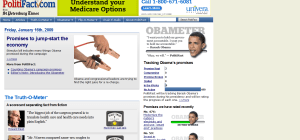
Romensko points out a fantastic new feature that will keep track of whether President-elect Obama keeps the promises he made.  The Obameter at PolitiFact.com

Obameter

Obameter

says so far he’s lived up to two of his 510 promises. What a fantastic way to hold politicians accountable. Not only is it easy to read, but it’s a fabulous source of infomation that is easily searchable. Fantastic job, St. Petersburg Times.

Newspaper job losses and humor

Romensko reports that the Boston Globe may cut up to 50 newsroom jobs. This follows yesterday’s Gannett announcement of employees taking a week without pay and massive layoffs at Gannett, among others, last year.

If you want to see the mounting tally of cuts at U.S. newspapers, check out papercuts. The site is depressing, but reality is reality. If you need a chuckle after the bad news, papercuts links to Overheard in the Newsroom, where users post random things they’ve heard at work.

Gannett paper mentions CEO’s salary in job cuts story

By now, those following journalism know that Gannett has asked its employees to take a one-week unpaid leave in order to save the company money.

I was thrilled to see my local Gannett paper, The Rochester Democrat and Chronicle, mention Gannett CEO  Craig Dubow’s salary — $1.2 million in 2007–in its story about the unpaid leave.

End of an era viewed with optimism

Jim Memmott wrote an interesting piece about the changeover of what could be New York state’s, if not the country’s, smallest daily newspaper to a weekly publication.

Perhaps the most surprising details were (1) no editorial  job losses and (2) the journalists’ optimism. The Salamanca Press‘s managing editor, Kip Doyle, told Memmott, “”We were losing what we are supposed to be, a community paper.”

Memmott’s piece brings together the history of the 142-year-old paper with a look to the future. It’s a very nice read for newspaper junkies.

Supreme Court likely to consider disgusting free speech case

Are you an absolutist? Do you believe no law should abridge free speech?

I am an absolutist, but an issue the Supreme Court is likely to tackle sure made me think about that.

The United States solicitor general asked the Supreme Court to look at whether a law that makes it illegal to sell videos depicting animal cruelty violates the First Amendment, according to Adam Liptak at the New York Times. The law in question does not make the animal cruelty illegal; other laws deal with the actual act. This law only criminalizes depiction of the act.

In a fascinating yet disturbing read, Liptak details how this law prohibits the sale of sexual fetish videos involving animal cruelty and dog fighting videos, among other things, and brings into question whether some speech simply has “no value.”

It’s a sick case. It’s hard to believe that anyone would want to see such images. But I guarantee this article and this case will make  you think about where to draw the line on free speech.

To e-mail or not to e-mail, that is the question

To my surprise, a post I wrote yesterday praising The College at Brockport‘s student newspaper, The Stylus, for getting the news of the spring concert act out to students over the break sparked some debate.

Dan Reimold at College Media Matters questioned the need for an e-mail alert to the story as opposed to simply posting the news on the web site. I appreciate his feedback. I’d like to clarify  that quite frankly I believe the e-mail alert was necessary because this is occurring during the break and students and members of the college community would not be checking the student newspaper web site for updates when they know the students aren’t there working on the next issue. (Full disclosure: I am the newspaper’s adviser, but knew nothing of the story or e-mail until I received the e-mail.)

I don’t think those receiving the e-mails would view them as cluttering their mailboxes. The community here would see this as big, breaking news. Maybe in New York City or San Francisco or a huge university this would not be big news, but here in Brockport it is. (And please don’t take that as a sign that The Stylus is a sleepy little paper. It’s not.)

Part of determining the importance of news and even what is news is knowing your community. I certainly don’t slight Mr. Reimold for not being familiar with Brockport. I just want to offer some clarification as to why I think it is fantastic that Stylus editor Amanda Seef broke the story over the break, with the first newspaper of the semester still weeks away. She got the story, didn’t wait for the announcement to be “officially” released by the college and recognized that this would be important enough to her readers to alert them. That is good journalism.

Strip searched for a libel suit

Can you imagined being awoken at 6:40 a.m., handcuffed and strip searched twice in the same month because someone in the justice system wanted to talk to you about a libel case?

According to Washington Post writer Edward Cody, that is exactly what happened to a French editor of the Liberation daily in Paris. An investigating magistrate said she took the action because the journalist hadn’t responded when summoned.

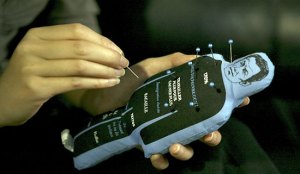
French President Nicolas Sarkozy wants to eliminate investigative magistrates because of abuses of power and a need for a greater presumption of innocence for the accused, Cody reports.  While his idea apparently has a lot of support, my guess is the investigating magistrates will be buying a lot of Sarkozy voodoo dolls in the coming days.

Photo of Sarkozy voodoo doll by Associated Press

Photo of Sarkozy voodoo doll by Associated Press

College journalists get 24/7 news cycle

While some traditional print journalists might not be catching on to the 24-hour news cycle (Buffalo News, why don’t you have Twitter updates yet?), I’m happy to report that some up-and-coming journalism students get it.

Most students at The College at Brockport, where I teach, won’t return until the spring semester at the end of January. No campus newspaper comes out until then, either.

That didn’t stop the college’s student newspaper, The Stylus, from sending out a breaking news email and updating its web site with the news that Third Eye Blind is tentatively scheduled for the spring concert. (Full disclosure: I advise the newspaper, but I knew nothing of this until the e-mail hit my inbox, just like the rest of the Brockport community.)

These students realize that journalism is a 24-hour-a-day job, regardless of the medium, and that when they find out big news, they can’t wait for the print edition or even, in their case, for when they return to school. I am confident they are not the only college journalists who work this way.

They are thinking “online first, print once or twice a week” as Martin Langeveld preaches. And that gives me hope for the future of journalism.