Court stymies attempt to limit ringtones

Finally, common sense prevails.

The fact that others can hear copyrighted music when your cell phone rings does not make you a copyright violator. That’s what a federal judge ruled last week in the U.S. District Court (Southern Division of New York State).
Media Law Case of the Week Logo
The American Society of Composers, Authors and Publishers (ASCAP) was suing Verizon and AT&T and argued that, in essence, when one’s cell phone rings, it creates a “public performance” of the copyrighted work, and THAT was copyright infringement.

Keep in mind that cell phone users already PAY royalty fees when they buy the ring tone.

The decision states, “ASCAP has not shown any infringement of its members’ rights by the playing of ringtones in public from Verizon’s customers’ telephones. The customers are not liable for copyright infringement, and neither is Verizon.”

For an article about the case and a link to the decision, see Wired’s piece here.
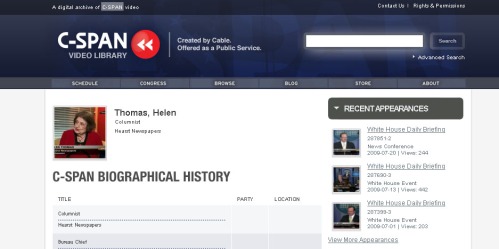
C-SPAN offers video treasure trove

Originally I planned to focus this post on a great documentary on the U.S. Supreme Court that C-SPAN has been showing — and which is also available for viewing online. I showed the piece to my media law class, and they were more interested than one might expect for a group of 20-somethings at 8 a.m. in the morning. I definitely recommend it for other media law teachers.

But while nosing around the C-SPAN site, I discovered a wealth of videos on everything from press conferences to in-depth interviews. I even found dozens of videos featuring one of my journalism heroes, Helen Thomas.

So if you are looking for clips from politicians, educators, journalists and business people, give the C-SPAN Video Library a try.

Helen Thomas Video

Media Law Case of the Week

So I guess Russians can say that Stalin was responsible for thousands of deaths after all.

Russian autocratic leader Josef Stalin’s grandson sued a Russian newspaper for libel after an article referred to Stalin as having sent thousands to their deaths. Today a Russian court ruled against the grandson.

The case had some in the country wondering if the government and courts would try to change history by denying Stalin’s responsibility.

Will the grandson appeal? We will know within five days.

Somber reminder not all journalists free

“I am still alive. I am one of the lucky journalists.”

That’s what Rochester Democrat & Chronicle Global Editor Maidstone Mulenga told the roughly 100 international journalists, students and teachers gathered at the United Nation of Rochester’s Freedom of the Press: A Global Crisis earlier this week held at The College at Brockport’s Metro Center.

Maidstone was a journalist in Zambia, and he and his family were threatened because of a story he had written. The government wanted to know his source. He said his story is not unique, and said that according to World Press Freedom Day, 673 journalists were arrested in 2008. Even worse, 70 journalists were killed. So far this year, 31 journalists have been killed and 30 journalists are missing worldwide, he said.

“Each time freedom of press is threatened, all other human rights are threatened,” he said.

He urged the audience to take action. He mentioned that when he visits journalists in Africa and sees them waiting in line to use the one computer available for them to follow reports, he wishes people would realize that they could help with freedom of the press by donating computers and technology or by giving a little money to support the families of imprisoned journalists, families often left destitute because the family bread-winner cannot work.

Some of the organizations that try to help international journalists and work to ensure a free press include:

I’m in love with iWeb

True confession: I went from Mac Hater to Mac Lover in the course of one hour.

I’m a PC person — I use PCs at home and, most of the time, at work. I do, however, teach one class on Macs. It was like trying to speak a foreign language. I’d try to hit my shortcut buttons and they didn’t work. Everything was in a different place. I didn’t know what I was doing, and quite frankly, blamed the Mac instead of me.

And then last week I was introduced to iWeb, the fabulous web site creation program on Macs. I’m in love. The designs (most of them, anyway) are beautiful and it is incredibly easy to use. Although I know HTML and CSS, I didn’t have to use any. And that got me thinking: What if this program — or one like it — could be used on multimedia news sites?

Not only would the sites be cleaner and easier to use for the news consumer, but it also would be easy for almost anyone on staff to update and tweak the sites. (Admit it, most news sites are not beautiful.)

And now I’m off to figure out a way to talk my husband into getting a Mac … 🙂

Media Law Case of the Week

“Don’t upset the apple cart …”

Maybe that old saying should be changed to, “Don’t upset Apple Inc.”

Peggy Watt at PC World writes a great piece about Apple Inc.’s attempt to claim that an Australian company is infringing on its trademark with its logo. She mixes humor and good ole’ media law facts to create the interesting piece.

Here, by the way, are the trademarks:

173106-woolworths_logo_180164271-Apple_logo_inline_original

What does lack of sex assault coverage mean?

The silence is deafening.

It sounds cliche, but I can think of no other way to describe the astounding lack of local media coverage of a reported sexual assault of a College at Brockport (SUNY) student by three men. The student was walking home on a village street and assaulted, according to reports.

The college media are covering it, as you can see here. But I have yet to see any mention of it in the mainstream media that covers the area. By the way, the mainstream media are located only about a half-hour away — less if you don’t drive at peak times.

How many days have passed? FOUR.

The College at Brockport did the right thing and made its students aware of the situation with a Campus Safety Alert e-mail. Thank goodness it did, because the community certainly isn’t learning about it through the mainstream media. (In the interest of full disclosure I will tell you I teach at The College at Brockport.)

But what happened to the local mainstream media?

I started wondering how on earth they could miss this big of a story and came to only one conclusion: the impact of the job cuts in the reporting industry are showing.

The Democrat & Chronicle, the local daily newspaper for this area, cut at least 59 jobs last year alone. It’s a Gannett company, so it also instituted the now-famous job furloughs.

The TV stations, with all due respect, appear to have been pretty thinly staffed since I arrived here a year ago.

So is missing the sexual assault of a college student the only thing the mainstream media have missed? I doubt it.

My hope is that as more and more stories are missed, media companies will realize they must hire more staff.

My fear is they simply don’t care.

Media Law Case of the Week

When is a libel threat really an attempt to muffle criticism, in particular press criticism?

Journalists at an Italian newspaper, La Repubblica, argue that Italian Prime Minister Silvio Berlusconi is trying to use his libel suit against the paper to do just that — shut up opposing voices, according to UK newspaper The Guardian.

And what did this paper do that the Prime Minister did not like?

La Repubblica has asked that Berlusconi answer “10 New Questions” about his relationships with several women — some of whom are reported to be prostitutes and at least one a minor.

The Guardian reports that the Italian newspaper is trying to get 500,000 people to sign an online petition calling for press freedom by Oct. 3 and that newspaper editors in Britain, Germany, Spain and France have signed it.

If you’d like to sign it, click here. To easily translate the petition from Italian to English, you can use Babel Fish.

Is it who or whom? It’s laughs.

Is it who or whom?

This clip from The Office will make you laugh if you’ve ever had one of these debates (and what writer hasn’t?). Thanks to Editor Extraordinaire Deborah Gump, Ph.D., for passing this one along.

Media Law Case of the Week

It was bound to happen.

The lawyer for the suspect in the Yale student’s murder is filing a complaint about law enforcement leaks about the case to the media.

Who can blame him?

At this point, even the casual news consumer knows that law enforcement claims Raymond Clark III’s DNA is all over the crime scene. Public Defender Joseph Lopez is laying the groundwork for a claim that it will difficult, if not impossible, for his client to get a fair trial.

Speaking of high profile cases that lead to difficulties in getting a fair trial, the Sam Sheppard case — which inspired “The Fugitive” — was back in the spotlight again on NPR after Sheppard’s son objected to host Scott Simon referring to his father as “the most famous convicted murderer in America.”

You can hear Simon’s interview with the son, Sam Reese Sheppard, here.