Category Archives: future of journalism

Newspaper boxes in museums

I took my daughter to the Strong National Museum of Play recently and noticed a couple of newspaper boxes like this in the exhibit for Sesame Street.
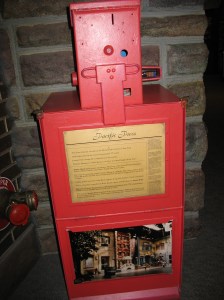
Museum of Play May 2009 048Five years ago, I wouldn’t have thought much of this. But today, with the current state of the newspaper industry, the sight of a newspaper box in a museum struck me as eerie. I couldn’t help but wonder if this was where newspaper boxes — and indeed, newspapers as we know them — were going to be. Not in our homes and in our hands, but in a museum exhibit.

My 4-year-old knows about newspapers. (How could she not when her mom used to work for one?) But it’s hard not to wonder if in the not-too-distant future children will be asking their parents what that box with the paper in it is when they tour exhibits like this. Five years ago, I don’t think it ever would have occurred to me that newspapers would be in the shape they are now. It’s not that much of a stretch to think that five years from now boxes like this will be gone for good — except for in museums.

Hero emerges in journalism hearings

I watched the Senate committee’s hearing on the future of journalism yesterday from my computer at work. Well, watched isn’t the right word. It was more listened to.

What struck me most about the hearings were two points:

  • The so-called “new media” folks testifying at the hearing are dreaming if they think citizen journalism can make up for having a news organization with the power and money to have reporters dedicated to stories, issues and people. (Can you image coverage of foreign affairs?) I’m not saying the news organization has to be paper based, but news organizations are essential. We can’t count on citizen journalists alone.
  • David Simon, former Baltimore Sun journalist and current Hollywood writer/producer, articulated so well what some of us print and former print journalists think. (For his full transcript click here.) One metaphor captured it precisely for me:

“The very phrase citizen journalist strikes my ear as nearly Orwellian. A neighbor who is a good listener and cares about people is a good neighbor. He is not in any sense a citizen social worker. Just as a neighbor with a garden hose and good intention is not a citizen firefighter. To say so is a heedless insult to trained social workers and firefighters.”

Thank you, David Simon. Thank you.

Real people, real dismay about journalism

Last night I delievered a talk about news literacy to the Brockport Rotary Club. The talk soon became a discussion on the current state of journalism.

What struck me most about the concerns the members shared with me was this: They want real community news. The good and the bad. And they don’t think they are getting it.

Directly related to that, they also want watchdog reporting. What are they getting? Octomom.

While we read headlines saying newspapers are dying or already dead, these residents subscribe to newspapers — for now — but say they are getting too thin and don’t have enough local content. The online versions don’t provide them with much more than the print.

Why do I bring this up? Because as every day we hear about more and more newspapers cutting staffs or mandating furloughs, newspapers are doing the EXACT OPPOSITE of what they should be doing.

How on earth can newspapers provide more local content with fewer people? In the short term newspapers may be cutting costs, but in the long term they are killing the industry.

I try not to be a pessimist, but some days it is hard to see the silver lining in all this.

I read today about a conference aimed at “sustaining journalism.” A Critical Convening meets later this month is Washington. I only hope that conferences like this can generate concrete ideas — and not just talk — that can help save newspapers.

Best of the Blogs for Teaching Journalism

I’m starting a new occasional feature here focusing on some good reads for journalism teachers. I will be sharing these blog posts with students in my journalism and web design classes.

Gina Chen’s Open Letter to Newspapers at savethemedia. She writes about what she wants from newspapers from the perspective of a newspaper reader, not a journalist. It’s excellent.

Mark Luckie’s Why Journalists Should Learn to Code at 10,000 Words. It’s difficult for journalism students to understand why knowing HTML and CSS might give them an edge. After all, it’s the story that matters, right? Luckie does a great job of explaining why coding matters.

Erica Smith’s Multimedia Toolkit:  55 Sites You Should Know About at graphicdesgnr. This will save me hours — literally — and give me lots of cool new tools to show my students.

Thanks to all for making the life of this journalism teacher a little easier and for making classes more interesting and relevant.

Why can’t online newspaper link?!

I love the Buffalo News.  I really do.

But give me a break.

In an ONLINE story about how the city of Buffalo government is releasing salary data online, the readers were given this direction.

The address for Buffalo’s Web site is http://www.city-buffalo.com. The salary data was originally posted on the home page under “Mayor Brown’s Transparent Government Initiative.” Late this afternoon, the title for the posting was changed to “City of Buffalo Employee Salary Information.”

NO hypertext. NO links. NO joke.

In essence, I view this as sending the following message:

“Dear Reader,

We know you understand all this newfangled web stuff, but we don’t. We’re going to try to help you, but this is the best we can do.

Or, if you don’t accept that explanation, how’s this? We’re too lazy to update the story for our web site.

Oh, but trust us to get details right.

Sincerely,

Your Newspaper”

I don’t think newspapers are dead. But they can’t bury their heads in the sand. They’ve got to keep up. Links are not too much for a reader to expect.

Shame on you, Buffalo News.

Random Thoughts on a Friday

Here are some random journalism-related thoughts and notes:

A blog I love: Ted Pease’s blog, Today’s Word on Journalism. Perhaps one of my favorite posts was one of this week’s words, “fish wrap,” in which a Facebook user opines about why he reads the paper. The words Pease chooses are cleverly linked to his point, and he finds great stuff.

Good journalism: Today’s New York Times has a story on new Sen. Kirsten Gillibrand’s (D-N.Y.) past as a lawyer for tobacco giant Philip Morris. New York Gov. David Paterson appointed Gillibrand to fill Hillary Clinton’s seat. This is important information for her constituents, who had no say in her representing them, to know.

Hope: Laid off reporters and editors from The Seattle Post-Intelligencer are trying to start web sites with in-depth journalism. They are working on ways to fund the sites. God speed. We need in-depth journalism now more than ever.

Over and out: The Buffalo Newspaper Guild voted in favor of a plan that will save jobs in exchange for employee give-backs and cost savings.

“No one is happy about the numerous families hurt by The News’ cutbacks,” said Phil Fairbanks, chairman of the Guild bargaining committee on the BNG web site. “Everyone in our union sacrificed to save jobs. Our hope now is that management will do its part to put the paper on firm financial footing and avoid future layoffs.”


The danger of the state of journalism

I’m normally an optimist, but I’m finding it difficult to be upbeat today. Yesterday I learned that many former colleagues of mine are among those

Danger Sign

Danger Sign

with 10-day furloughs and pension freezes as Advance Publications attempts to help the bottom line, and also that Gannett journalists I know are facing their second furlough for the same reasons.

Today I read that Janice Okun is retiring from the Buffalo News on March 31, the same day the Buffalo News had previously reported those accepting buyouts would have to be off the payroll. Thirty-six members of the Buffalo Newspaper Guild (not all editorial) took that offer. (Okun will continue writing reviews as a freelancer, but will no longer be a staffer.)

I couldn’t help thinking about all this when, in my media law class, we were talking about the importance of  Freedom of Information Act and state Freedom of Information Laws. Students brought in examples of stories where government records were used.

Among them was this gem:

The city of Auburn would not release the names of two employees who took equipment until two newspapers — The Post-Standard and The Auburn Citizen–filed a notice that they intended to sue the city for the names.

My question is, with journalists working fewer hours (if at all), who is going to do these stories? Who is going to find out about this stuff?

I know some new media types say citizen journalists or bloggers will do it. Really? In a small city like Buffalo, Rochester or Syracuse someone who works a paying job is going to have time to file foia/foil requests and hold public officials accountable?

And please don’t tell me TV and radio journalists will do it. Government record stories don’t have exciting visuals, and TV and radio journalism staffs are cut to the bone, too.

This newspaper crisis has far deeper implications than what happens to journalists. It’s about what happens to our society.

As Francis Bacon said, “Knowledge is power.” But let’s face it:  We are losing a major conduit to that power.

Buffalo News full-time editorial employees safe from layoffs

The Buffalo News and the Buffalo Newspaper Guild have reached an agreement that will mean only two part-time sports clerks will lose their jobs in the newsroom. Outside the newsroom, at least seven jobs are proposed to be cut.

Guild members have to vote on the plan — which includes giving up raises, bonuses and higher Sunday pay — on Thursday, according to the Guild.

While the news that full-time newsroom employees won’t be facing the chopping block is good, it’s hard to take any kind of pleasure in this. The fact is the Guild is giving up a lot to save the jobs. And the News has lost several experienced, brilliant reporters to its cost-cutting buyouts. Case in point:

  • Sharon Linstedt, News business reporter recently lauded by the paper’s Editor, Margaret Sullivan, for her coverage of the crash of Flight 3407, which killed all aboard the plane and one on the ground. Sullivan wrote: “By 4 a. m., Linstedt had become a major source of information for the world, providing audio interviews for NBC, MSNBC, ABC and CBS. Linstedt was also the first to report that 9/11 activist Beverly Eckert was one of the victims.” That grit, expertise and experience will be gone from the paper by month’s end.
  • Fred Williams, perhaps best known for his business reporting. Recently, he’s been covering community news, including the beheading of a prominent Orchard Park woman.
  • Howard Smith, managing editor and former sports editor, who ended up in the media spotlight himself when News Sports reporter Tom Borrelli died last year from injuries sustained in a fall while covering a game and Smith was asked to comment on Borelli’s accomplishments.

While I’m happy that it appears the News might avoid newsroom layoffs of full-time employees at this time, my heart goes out to the folks in the Buffalo News newsroom, who in the past six months have dealt with the tragedy of the Flight 3407 crash, the unexpected death of a colleague who was covering a game, and the threat of losing their jobs.  Hang in there. Better days are coming.

Idea: Get unemployed journalists to teach news literacy

Perhaps the greatest news to come out of last week’s “News Literacy:  Setting a National Agenda” conference at the State University of New York at Stony Brook was this:  The University’s Center for News Literacy is working on a proposal aimed at hiring 50 unemployed journalists and training them to teach in colleges throughout the country. The goal is to have government and foundation grant money pay for the salaries and the training of these journalists.

When Howard “Howie” Schneider, dean of the University’s journalism school, asked if any of the nearly 100 educators, administrators and journalists attending the conference on Long Island Friday would like to have one of these journalists for their schools, hands quickly shot into the air.  The John S. and James L. Knight Foundation has awarded SUNY Stony Brook a grant to help find full funding for the project. The hope is that some of the education money the Obama administration has targeted at education might be used for this project, along with foundation money that SUNY Stony Brook hopes to secure.

It is a fabulous idea that takes a step toward solving two major problems in journalism:  the unemployment of experienced, excellent journalists and the inability of many news consumers to differentiate between quality journalism and propaganda, public relations and/or shoddy journalism. The goal of this conference was to discuss ways to integrate classes on being a savvy news consumer into high school and college/university curriculums. I can think of no better way to get students interested than to have “guest teachers” who worked in journalism talk about the ins and outs of understanding the news.

Here’s hoping SUNY Stony Brook can pull this off. My hat’s off to the teachers and administrators at Stony Brook for their innovation and dilligence.

Highlights for the national News Literacy conference

Here are a few highlights from today’s News Literacy:  Setting a National Agenda conference at SUNY Stony Brook:

  • News Literacy:  An overview of the News Literacy class at Stony Brook demonstrated ways teachers can show students how to analyze news coverage and judge reliable, verifiable information.
  • Ted Koppel and the News Media Panel:  This was the highlight of the day. Alexandra Wallace, senior vice president of NBC News, said journalists need to be entertaining and engaging, noting the news doesn’t have to be boring. Koppel, former host of Nightline and longtime journalist, responded that entertainment was not the job of the journalist. “We have to inform,” he said. Some things are dull, he said, but we need to know them. Surprisingly, this drew only a few claps from the audience. Koppel also talked about his concerns about journalism. “I don’t think the democraticization of news gathering is in and of itself a good thing,” he said, noting that readers can’t judge biases and where people are coming from with blogs. With the legacy media (print, broadcast), “There are people who made sure standards are met,” he said. If these standards are not met, people will dump that media outlet, he said.
  • Money, Money, Money:  Journalism job cuts and their impact on news content came up several times. Case in point:  One of the audience members asked about the lack of international coverage in broadcast news. “It’s not that we don’t want to,” Wallace said. “We can’t afford to.”
  • Arthur Sulzberger Jr., New York Times publisher:  He spoke at day’s end about the current state of The Times. He said The Times is exploring paid content options, has seen print subscriptions grow the past two years (despite the perception of the death of print) and sees no end to print publication of The Times.
  • Quote of the day:
  •                   “Cable news seems to be in a desperate rush with the obvious.”–Ted Koppel  

Perhaps