Ah, Onion, you’ve done it again.
If you need a laugh, be sure to check out:
Right To Privacy Not Guaranteed By Constitution, Says Supreme Court Justice Peeking In Bathroom Window

Ah, Onion, you’ve done it again.
If you need a laugh, be sure to check out:
Right To Privacy Not Guaranteed By Constitution, Says Supreme Court Justice Peeking In Bathroom Window
I’ve decided to start a new feature on my blog: Media Law Case of the Week.
The Media Law Case of the Week will appear on Mondays and feature a case I think is interesting, different and/or important. I decided that since I’m combing the Net for interesting cases for the media law class I teach, I may as well start sharing the best of what I find on my blog.
So, without further ado, the Media Law Case of the Week:
It’s not often a libel case involves a Disney star and an escort service, but the recently settled case of “Suite Life” star Brenda Song fits the bill. Ads for an escort service ran with Song’s picture and the slogan “Hawaiin [sic] beauty. Come get lei’d.” in LA Weekly in April 2008. The kicker is Song never authorized the use of her image. She sued for libel, emotional distress and commercial appropriation of her likeness. (Oh those pesky details … ) For details of the case and the settlement, check here.
If you value free speech (and who doesn’t?), this will send a chill down your spine. I know it did mine.
Newsweek, the LA Times and other media outlets are reporting that a Justice Department memo secretly advised the Bush administration that it could suspend First Amendment speech rights if needed to fight the war on terror. The memo on “Authority for Use of Military Force to Combat Terrorist Activities Within the United States” was issued in October 2001 and not revoked until seven years later, right before Bush left office.
What?!
This memo, released with others this week by the Obama adminstration, also indicated it would be legal to spy on Americans with high tech equipment and deploy the U.S. military within the U.S. itself for operations against terrorists. “We believe these operations generally would not be subject to the constraints of the Fourth Amendment, so long as the armed forces are undertaking a military function,” the memo concludes.
Ah, the Fourth Amendment. What was that one about again? That’s right–unreasonable search and seizures.
And what does this memo say about our beloved First Amendment?
“First Amendment speech and press rights may also be subordinated to the overriding need to wage war successfully,” the memo states on Page 24.
See the memo for yourself here.
A Tennessee lawmaker’s lawyer is claiming that his client is immune from a libel suit after he falsely wrote on his blog that a candidate had been arrested on drug charges because the blog is “absolutely privileged.”
Huh?
I’m no lawyer, but I know that is not going to fly. Rep. Stacey Campfield, R-Knoxville, better say mea aculpa or get a new lawyer. Roger Byrge, a Democrat who lost his bid for the state House to Republican Chad Faulkner, filed a $750,000 libel suit against Campfield for writing that Byrge had had multiple drug arrests.
The Chattanooga Times Free Press wrote:
In the Oct. 12 blog post, Campfield said more attention needed to be paid to the race for the open seat in House District 36.
“Word is a … mail piece has gone out exposing Byrge’s multiple separate drug arrests,” Campfield wrote on the blog. “Including arrests for possession and drug dealing. (I hear the mug shots are gold).”
The parts of the post mentioning Byrge are no longer on Campfield’s blog, but a printout of the original text is filed as an exhibit in the lawsuit.
Thanks, Roger Clemens, for making it easier for my media law students to understand libel, and more importantly, libel defenses.
It can be hard for some students to get a grasp of the libel defense absolute privilege, which protects participants in certain government proceedings. But baseball star Clemens has made the concept more relevant to my students.
The New York Times reports that a large part of Clemens’s defamation case against former trainer Brian McNamee over Clemens’s alleged steroid use has been thrown out of federal court because McNamee’s statements were made during an official federal investigation. That means McNamee is protected by absolute privilege.
That’s libel defense in action with names students know. And that’s a great teaching tool. So thanks again, Mr. Clemens, for helping my students’ libel knowledge “rocket.”
The Buffalo News reports that one day before News sports reporter Tom Borrelli fell to his death on stairs while covering a game at a Buffalo school those same stairs had been inspected by the state.
That state inspection uncovered five safety violations that led to charges filed in January — roughly two months after Borrelli’s death from injuries sustained in the fall.
How did the News learn this? Through a Freedom of Information request to the New York State Labor Department’s Public Employee Safety and Health Bureau.
The story details warnings ignored and cost-cutting measures that led to the accident that killed Borrelli, a member of the National Lacrosse League’s Hall of Fame. This story leaves one feeling that Borrelli’s life was needlessly lost. Sadly, in the end, it will be the students of the Buffalo school district who end up paying for the stupidity that led to Borrelli’s death, as the district now faces a potential lawsuit on top of the cost of the repairs.
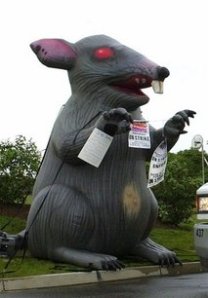
This file photo by the Associated Press shows a large, inflated rat used at a N.J. union protest in 2001.
And now, for a moment of levity after days of media coverage of tragedies …
A rat wins a free speech case case, and free speech advocates should cheer.
The rat, pictured above, is used by unions nationwide as a symbol of a labor dispute. But in New Jersey, the Associated Press reports, police in Lawrence Township fined the International Brotherhood of Electrical Workers union local for using the rat.
New Jersey’s state Supreme Court ruled that the First Amendment protects the rat as free speech and that the township’s law, which allowed some kinds of signage and not others, was not content neutral.
The Committee to Protect Journalists has asked President Obama to look at the U.S. military’s detention of journalists.
The group says that 14 journalists have been held for long periods of time in Iraq, Afghanistan and Guantanamo without due process. One of the 14 remains so.
The group also says that 16 journalists have been killed by the U.S. military in Iraq since 2003.
The committee’s report serves as a reminder that we must hold our government accountable for its actions.
Have you ever wondered how your state fares when it comes to open information about the government?
The Knight Citizen News Network has a state-by-state guide in which it grades state web sites on online, open government information. (My state, New York, gets a thumbs up. Check out your state by clicking on it here.) The evaluation also includes links to that state’s government information.
The feature is part of the Knight Citizen News Network’s Citizen Journalist’s Guide to Open Government, which has lots of great information on how people can access government records.
Posted in Media Law
Tagged citizen journalism, FOIA, freedom of information, future of journalism
A police officer in Rochester, NY, was shot in the head while walking away from a group that police had questioned but not arrested. Three days later, a 14-year-old turns himself into police, according to police and judicial officials at a press conference. They did not name him during the press conference.
The child (and to me, a 14-year-old is a child, not a man) pleaded not guilty to first-degree assault and second-degree attempted murder. Although charged as a juvenile, his case is in adult court and his name was in The Democrat & Chronicle’s news story Feb. 4 and his photo was on the web site. His face and name were also all over R-News, WHEC-TV, WOKR-TV and WROC-TV.
The child had been in trouble with the law before this and had not reported to the people supervising him since April 2008, according to the D&C. The D&C’s editorial board is right to ask, “How is it that a 14-year-old can go for nearly a year without reporting for adult supervision as required?”
I’m not sure, however, that the D&C and other Rochester area news media are right to use this child’s name and image. He is innocent until proven guilty and he is 14. Just because journalists have the name and image does not mean they should use them.
The shooting has been an emotional story that has gripped the Rochester, NY, region. Prayers, donations and messages of support for the police officer and his family rightfully abound.
My concern is that, after the media coverage, this child, regardless of the verdict, will never be seen as anything but an attempted cop killer. Some of the people posting reactions to today’s D&C story are already calling for the death penalty and talking as if he has been convicted. This child has already been sentenced for life.
Posted in Ethics, Media Law, technology
Tagged free speech, journalism, journalism ideals, journalists in court
 journajunkie