Category Archives: newspapers

Could U.S. government help newspapers after all?

When French President Nicolas Sarkozy announced Friday that the government would help the ailing country’s newspaper industry with millions of dollars in state aid,  I was skeptical about such a plan working in the U.S. because of the perception of close ties between government officials and journalists that such aid might create.

Geneva Overholser, director of the Annenberg School of Journalism at the University of Southern California, and Geoffrey Cowan, dean emeritus of USC’s Annenberg School, have changed my mind about government aid for journalism. In a LA Times piece written before the French announcement, the duo point out the history of the U.S. government financially aiding and/or encouraging journalism. They also posit some ways the government could help now, including subsidies and tax changes.

The piece is not a wish list. They still hold journalists and newspapers accountable for innovative content and creation of  a working economic model. But they argue convincingly that print journalists cannot save the industry alone.
France to aid newspaper industry

French President Nicolas Sarkozy announced today that the government will try to help the ailing print newspaper business in several ways. They include:

*Giving free newspaper subscriptions to 18 year olds

*Covering more delivery costs

*Buying more ads

Sarkozy said,

“It is indeed its (the state’s) responsibility … to make sure an independent, free and pluralistic press exists.”

Wow. What a different way to approach this. In the U.S., I think government aid to newspapers in this fashion would have journalists worried about a perceived conflict of interest, not to mention what would happen the first time a journalist wrote a story that the president or government officials vehemently did not like.

But wouldn’t it be wonderful if even a part of this — say, giving teens a gift subscription to a newspaper on their 18th birthday–could be adopted here? To be good citizens, people need to be informed. I see how Sarkozy can view this as part of the state’s responsibility.

Sarkozy says his plan is intended to give newspapers time to transform and adapt to be multiplatform, offering their stories through multiple vehicles.

But as Sarkozy noted, government aid is not going to save the industry if it doesn’t change and adapt.

Fabulous watchdog journalism

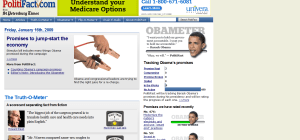
Romensko points out a fantastic new feature that will keep track of whether President-elect Obama keeps the promises he made.  The Obameter at PolitiFact.com

Obameter

Obameter

says so far he’s lived up to two of his 510 promises. What a fantastic way to hold politicians accountable. Not only is it easy to read, but it’s a fabulous source of infomation that is easily searchable. Fantastic job, St. Petersburg Times.

Newspaper job losses and humor

Romensko reports that the Boston Globe may cut up to 50 newsroom jobs. This follows yesterday’s Gannett announcement of employees taking a week without pay and massive layoffs at Gannett, among others, last year.

If you want to see the mounting tally of cuts at U.S. newspapers, check out papercuts. The site is depressing, but reality is reality. If you need a chuckle after the bad news, papercuts links to Overheard in the Newsroom, where users post random things they’ve heard at work.

Gannett paper mentions CEO’s salary in job cuts story

By now, those following journalism know that Gannett has asked its employees to take a one-week unpaid leave in order to save the company money.

I was thrilled to see my local Gannett paper, The Rochester Democrat and Chronicle, mention Gannett CEO  Craig Dubow’s salary — $1.2 million in 2007–in its story about the unpaid leave.

End of an era viewed with optimism

Jim Memmott wrote an interesting piece about the changeover of what could be New York state’s, if not the country’s, smallest daily newspaper to a weekly publication.

Perhaps the most surprising details were (1) no editorial  job losses and (2) the journalists’ optimism. The Salamanca Press‘s managing editor, Kip Doyle, told Memmott, “”We were losing what we are supposed to be, a community paper.”

Memmott’s piece brings together the history of the 142-year-old paper with a look to the future. It’s a very nice read for newspaper junkies.

To e-mail or not to e-mail, that is the question

To my surprise, a post I wrote yesterday praising The College at Brockport‘s student newspaper, The Stylus, for getting the news of the spring concert act out to students over the break sparked some debate.

Dan Reimold at College Media Matters questioned the need for an e-mail alert to the story as opposed to simply posting the news on the web site. I appreciate his feedback. I’d like to clarify  that quite frankly I believe the e-mail alert was necessary because this is occurring during the break and students and members of the college community would not be checking the student newspaper web site for updates when they know the students aren’t there working on the next issue. (Full disclosure: I am the newspaper’s adviser, but knew nothing of the story or e-mail until I received the e-mail.)

I don’t think those receiving the e-mails would view them as cluttering their mailboxes. The community here would see this as big, breaking news. Maybe in New York City or San Francisco or a huge university this would not be big news, but here in Brockport it is. (And please don’t take that as a sign that The Stylus is a sleepy little paper. It’s not.)

Part of determining the importance of news and even what is news is knowing your community. I certainly don’t slight Mr. Reimold for not being familiar with Brockport. I just want to offer some clarification as to why I think it is fantastic that Stylus editor Amanda Seef broke the story over the break, with the first newspaper of the semester still weeks away. She got the story, didn’t wait for the announcement to be “officially” released by the college and recognized that this would be important enough to her readers to alert them. That is good journalism.

College journalists get 24/7 news cycle

While some traditional print journalists might not be catching on to the 24-hour news cycle (Buffalo News, why don’t you have Twitter updates yet?), I’m happy to report that some up-and-coming journalism students get it.

Most students at The College at Brockport, where I teach, won’t return until the spring semester at the end of January. No campus newspaper comes out until then, either.

That didn’t stop the college’s student newspaper, The Stylus, from sending out a breaking news email and updating its web site with the news that Third Eye Blind is tentatively scheduled for the spring concert. (Full disclosure: I advise the newspaper, but I knew nothing of this until the e-mail hit my inbox, just like the rest of the Brockport community.)

These students realize that journalism is a 24-hour-a-day job, regardless of the medium, and that when they find out big news, they can’t wait for the print edition or even, in their case, for when they return to school. I am confident they are not the only college journalists who work this way.

They are thinking “online first, print once or twice a week” as Martin Langeveld preaches. And that gives me hope for the future of journalism.

Dear President Obama …

The Buffalo News features a nice editorial on why President-elect Obama should make a federal shield law a priority. (A shield law is a law that protects journalists from having to reveal confidential sources. Currently, some states have shield laws, but there is no federal shield law. Check here to see if your state has one.)

The Society of Professional Journalists has also recently called upon Obama to support a federal shield law as he indicated he would do during the campaign.

With the economy and the wars in Iraq and Afghanistan, it’s safe to say that gathering support for a federal shield law is not one of Obama’s top priorities. However, it should be. If we are going to get this country back on track, we need journalists to hold people in power accountable. To do that, they need to know they are not going to face prison for reporting an accurate story with an anonymous source whom they refuse to reveal. Journalists want “change we can believe in,” too.

Fewer reporters=watchdog journalism?

After 59 jobs were cut, the Democrat and Chronicle has expanded its watchdog/investigative reporting team from two to three reporters. So says Karen Magnuson, editor and vice president of news at the Gannett paper.

She mentions budget challenges, but writes:

I truly believe we editors have a special calling. We have a mission like no other in serving our communities. No matter what the challenge is, we must uphold our First Amendment responsibilities by shining a light on things that would otherwise go unreported.

I applaud the commitment to watchdog journalism. I just hope they can do it. The Gannett job cuts have practical implications that cannot be ignored. Daily news still needs to get covered, yet fewer people are there to do it. And from what I’ve heard of the D&C job cuts, more experienced journalists were let go than less experienced journalists.

Godspeed, Karen Magnuson and the D&C’s watchdog team. I look forward to following this.