Using Clemens case to teach libel

Thanks, Roger Clemens, for making it easier for my media law students to understand libel, and more importantly, libel defenses.

It can be hard for some students to get a grasp of the libel defense absolute privilege, which protects participants in certain government proceedings. But baseball star Clemens has made the concept more relevant to my students.

The New York Times reports that a large part of Clemens’s defamation case against former trainer Brian McNamee over Clemens’s alleged steroid use has been thrown out of federal court because McNamee’s statements were made during an official federal investigation. That means McNamee is protected by absolute privilege.

That’s libel defense in action with names students know. And that’s a great teaching tool. So thanks again, Mr. Clemens, for helping my students’ libel knowledge “rocket.”

FOI request hits close to home

The Buffalo News reports that one day before News sports reporter Tom Borrelli fell to his death on stairs while covering a game at a Buffalo school those same stairs had been inspected by the state.

That state inspection uncovered five safety violations that led to charges filed in January —  roughly two months after Borrelli’s death from injuries sustained in the fall.

How did the News learn this? Through a Freedom of Information request to the New York State Labor Department’s Public Employee Safety and Health Bureau.

The story details warnings ignored and cost-cutting measures that led to the accident that killed Borrelli, a member of the National Lacrosse League’s Hall of Fame. This story leaves one feeling that Borrelli’s life was needlessly lost. Sadly, in the end, it will be the students of the Buffalo school district who end up paying for the stupidity that led to Borrelli’s death, as the district now faces a potential lawsuit on top of  the cost of the repairs.

Rat wins peculiar free speech case

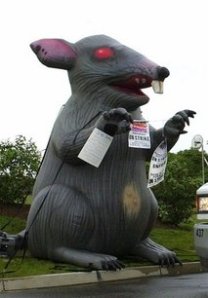
This file photo by the Associated Press shows a large, inflated rat used at a N.J. union protest in 2001.

This file photo by the Associated Press shows a large, inflated rat used at a N.J. union protest in 2001.

And now, for a moment of levity after days of media coverage of tragedies …

A rat wins a free speech case case, and free speech advocates should cheer.

The rat, pictured above, is used by unions nationwide as a symbol of a labor dispute. But in New Jersey, the Associated Press reports, police in Lawrence Township fined the International Brotherhood of Electrical Workers union local for using the rat.

New Jersey’s state Supreme Court ruled that the First Amendment protects the rat as free speech and that the township’s law, which allowed some kinds of signage and not others, was not content neutral.

Multiple platforms mean great journalism on crash

Like many, I’ve been following coverage of the crash of Flight 3407. And like many, I have a special interest — I live an hour from Buffalo, I lived five minutes from the crash site until six months ago, and I know many people in the Buffalo region.

To say I have been impressed with the coverage done by Buffalo journalists would be an understatement. It’s Sunday at 1:40 and the manifest with the names of those aboard Flight 3407 has yet to be released by the airline or the authorities. The Buffalo News, however, has been updating its list of victims since Friday. The list is simply a list of names now because The News has done short vignettes on the victims it knows about. But on Friday, that list inc luded a sentence or two about each victim and was updated throughout the day and night. It was powerful, personal and, it goes without saying, great reporting.

Editor & Publisher noted that “CNN cited updates from the News online reports, starting two hours after the crash.”

How did the News gather all of the information for its stories? Editor Margaret Sullivan told E & P that 50 to 75 people were working the story Friday. Some of those people came about there information the old-fashioned way:  talking to people face to face or working the phones. At least one reporter, Stephen Watson, turned to social media like Facebook and Twitter, where he issued a polite, sensitive request for any information about the victims or family of victims.

The News also did a terrific job with multimedia, putting up photos, videos, audio and slideshows of the people and the crash.

The News was not alone in its stellar coverage of this tragedy. WGRZ-TV Channel 2 in Buffalo, a Gannett company, also did superior work. The channel streamed its broadcast live Friday so those unable to get the Buffalo coverage on their TVs could see and hear what was going on. When I was watching it Friday afternoon, some 5,000 people were watching the streamed broadcast along with me. Amazing. The anchors, Jodi Johnston and Pete Gallivan, spoke directly to the web audience during commercial breaks, often reading comments that were posted online and talking about them.

I cannot close this praise of the work of Buffalo journalists without mentioning WIVB-TV‘s Lisa Flynn‘s insightful, probing questions. She asked at least five questions, all of them wonderful, at yesterday’s press conference with the National Transportation Safety Board, which was aired live here in Rochester, NY.

While I praise these journalists for all their fine work on this tragedy, I’m sure they, like us, would rather they had not had to cover this at all.

WGRZ-TV’s multimedia coverage of crash

WGRZ-TV in Buffalo has had amazing multimedia coverage of the plane crash in Buffalo that killed 50. At its site, you can watch local TV coverage live as well as get updates on everything from some of the names released to a Facebook group formed for people to come together to support one another.

When going to commercial, the anchors are continuing to talk to online viewers, addressing them directly and telling them what is coming up next. Right now, at 10:54 a.m. Friday, more than 3700 online are watching the live feed.

U.S. detainment of journalists

The Committee to Protect Journalists has asked President Obama to look at the U.S. military’s detention of journalists.

The group says that 14 journalists have been held for long periods of time in Iraq, Afghanistan and Guantanamo without due process. One of the 14 remains so.

The group also says that 16 journalists have been killed by the U.S. military in Iraq since 2003.

The committee’s report serves as a reminder that we must hold our government accountable for its actions.

Saving newspapers with The Daily Show

If you haven’t read Walter Isaacson’s Time Magazine piece “How to Save Your Newspaper,” you need to do so. He proposes a logical step to getting newspapers back on the right track, although I must admit that, in light of his ideas, I am feeling a bit guilty about sending you to the link to the free story as opposed to encouraging you to buy the magazine…

Isaacson appeared on The Daily Show with Jon Stewart last night to talk about the article. The interview is here.

Funny NY Times ad spoof

This speaks for itself.

Knight grades state web sites

Have you ever wondered how your state fares when it comes to open information about the government?

The Knight Citizen News Network has a state-by-state guide in which it grades state web sites on online, open government information.  (My state, New York, gets a thumbs up. Check out your state by clicking on it here.) The evaluation also includes links to that state’s government information.

The feature is part of the Knight Citizen News Network’s Citizen Journalist’s Guide to Open Government, which has lots of great information on how people can access government records.

Education official uses own typos for good

What a great idea for a news story.

The BBC reports that England’s Schools Minister is now asking students to pay more attention to proofreading and using his own error-ridden blog as an example of why you should be careful.

I bet if education reporters in the United States looked at communication from school officials it wouldn’t be too hard to find typos and errors. Why not do a story about it?