Category Archives: newspapers

5 Things Newspapers Could Learn from ‘Paperboy’

I recently took a walk down memory lane and revisited the 1980s arcade game Paperboy, which spawned many “remakes” and versions released for video gaming systems including some around today. Today I’d like to offer you five things newspapers could learn from that game.

  1. Get the news in your customers’ hands. Paperboy does whatever he has to do in order to get the newspaper to his customers. Avoiding pedestrians and break dancers? No problem. Zombies? No problem. Newspapers outside the game world should also go to any lengths necessary to get their news to their customers. I don’t know how newspapers can do that when they are hacking their staffs apart. There are few left to do this work.
  2. If someone does not read your newspaper, hit them over the head with it. In the 1980s arcade game Paperboy, the paperboy vandalizes the houses of non-subscribers. In other versions of the game, Paperboy receives points for getting the newspaper to hit certain targets in non-subscribers’ yards. While I’m not advocating vandalism, newspapers need to  figure out a way to get non-subscribers to see the paper. If they never look at it, they won’t buy it. And if they do look at it but can get the exact same product for free online, why pay? If you want people to pay, you have to offer them something they can’t get for free and show them it so they want it. The paper version has to have something different than online OR you have to start charging for online stories like you do the paper version.
  3. Celebrate your successes. Tell your readers (whether in print or online) what you do well. When Paperboy gets a week’s worth of newspapers delivered successfully to his customers, a banner headline pops up proclaiming this. While newspapers shouldn’t be patting themselves on the back for simply delivering the paper, they should spend more time pointing out to readers what they do well. For example, why don’t newspapers remind readers that the journalists are the public’s eyes and ears? This is simplistic, but what about the occasional reminder along the lines of this: “You’re busy. You have to juggle work, family and a million other tasks. We understand. You can’t be there, but you care. We will be there for you and tell you what you need to know. Just like we have been for decades.”
  4. If you move too slowly, you will be pushed in a direction you don’t want. When Paperboy did not move quickly enough to deliver the news, he was pushed by winds or swarms of bees. Newspapers have been slow to react to the online transition. The longer they wait, the longer they don’t take chances, the more likely they will be pushed in a direction they don’t want. It may already be too late, but I hope not.
  5. Above all, stay alive. Paperboy had to avoid everything from traffic hazards to tornadoes in order to stay alive on his delivery route and get the news in people’s hands. Newspapers have to battle financial problems that threaten to kill the industry. Paperboy did what he had to do to avoid his obstacles. Newspapers must do the same. If keeping the news organization alive requires new ways of thinking and taking chances, do it. If keeping the news organization alive means putting most of your effort into the online, not paper, version of the product, do it. If keeping the news organization alive means being different and going out on the proverbial limb all by yourself, do it. Be like Paperboy. Be brave. Or you’ll lose your job.
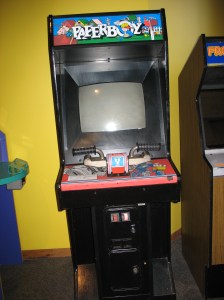
Paperboy: The video game

Paperboy arcade game

Paperboy arcade game

Ah, memories.

I recently saw an old Paperboy arcade game. The 1980s game had players take the paperboy through a variety of adventures and obstacles to deliver the paper to subscribers (and to throw extra papers at non-subscribers). You win by successfully delivering a week’s worth of newspapers to your subscribers.

My nostalgia led me on a hunt to find out the history of Paperboy. Did you know Paperboy has its own Wikipedia link and that there was a version that allowed you to choose to be  a Papergirl instead of a Paperboy? To my surprise, I also learned a version of Paperboy was released for XBox 360 in 2007.

It’s ironic, to say the least, that a video version of Paperboy might outlive the “career” itself. I wonder:  If we threw newspapers at non-subscribers like Paperboy, could we get them to subscribe?

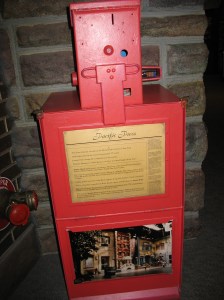
Newspaper boxes in museums

I took my daughter to the Strong National Museum of Play recently and noticed a couple of newspaper boxes like this in the exhibit for Sesame Street.

Museum of Play May 2009 048Five years ago, I wouldn’t have thought much of this. But today, with the current state of the newspaper industry, the sight of a newspaper box in a museum struck me as eerie. I couldn’t help but wonder if this was where newspaper boxes — and indeed, newspapers as we know them — were going to be. Not in our homes and in our hands, but in a museum exhibit.

My 4-year-old knows about newspapers. (How could she not when her mom used to work for one?) But it’s hard not to wonder if in the not-too-distant future children will be asking their parents what that box with the paper in it is when they tour exhibits like this. Five years ago, I don’t think it ever would have occurred to me that newspapers would be in the shape they are now. It’s not that much of a stretch to think that five years from now boxes like this will be gone for good — except for in museums.

Continuing coverage of the Buffalo crash

These aren’t stories I want to read.

However, I can’t help myself.

The Buffalo News is continuing to do an outstanding job covering the aftermath of the fatal crash of Continental Connection Flight 3407.

Case in point:  Today the News published the name and story of the final previously unnamed passenger on the doomed flight, graduate student Dipinder Sidha.

Throughout the days, weeks and months following the crash, the News did not give up on publishing the stories of those who died in that day — despite the fact the some names were not released by the airlines or, in some cases, the families.

The News’s coverage of the National Transportation Safety Board’s hearings on the flight includes stories on the event and the families, an animation of the flight’s final minutes, a live webcast of the hearings and links to NTSB reports on the crash.

It’s a multimedia treasure trove of all one might want to know about the doomed flight. It’s a great public service for all those, whether in Buffalo or elsewhere, who were gripped by the crash.

One can only hope that such public acknowledgment that the crash might have been prevented will lead to changes in training and staffing of airline pilots.

Good job, Buffalo News.

Hero emerges in journalism hearings

I watched the Senate committee’s hearing on the future of journalism yesterday from my computer at work. Well, watched isn’t the right word. It was more listened to.

What struck me most about the hearings were two points:

  • The so-called “new media” folks testifying at the hearing are dreaming if they think citizen journalism can make up for having a news organization with the power and money to have reporters dedicated to stories, issues and people. (Can you image coverage of foreign affairs?) I’m not saying the news organization has to be paper based, but news organizations are essential. We can’t count on citizen journalists alone.
  • David Simon, former Baltimore Sun journalist and current Hollywood writer/producer, articulated so well what some of us print and former print journalists think. (For his full transcript click here.) One metaphor captured it precisely for me:

“The very phrase citizen journalist strikes my ear as nearly Orwellian. A neighbor who is a good listener and cares about people is a good neighbor. He is not in any sense a citizen social worker. Just as a neighbor with a garden hose and good intention is not a citizen firefighter. To say so is a heedless insult to trained social workers and firefighters.”

Thank you, David Simon. Thank you.

A man who loves his newspaper

This hysterical look at a man who loves his newspaper is on YouTube. Maybe national ads like this would get attention for newspapers …

Newspaper fined for reporter’s fall?!

Let me get this straight.

According to a Buffalo News story by Michael Beebe, inspectors at the federal Occupational Health and Safety Administration want to fine the News $31,500 for allowing its sports reporter to go to an unsafe press box while covering a game.

What?!

Sports reporter Tom Borrelli died last year from injuries he sustained when he fell while climbing stairs to a press box at Buffalo’s All High Stadium. The Buffalo school district has since been cited by New York state investigators for five safety violations involving those stairs.

But an OSHA inspector tells Beebe in the story that because the News did not “prevent” its reporters from using the press box it should be fined.

Under this rationale, does it not seem logical that the government should/would fine media outlets for not “preventing” their reporters from reporting in unsafe conditions like — oh, I don’t know — WARS?

Areas where there are a lot of crimes?

Fire and crime scenes?

The list could go on and on. And this case could set a chilling precedent for news organizations. Do they decide to risk potential fines or do they decide to not cover a story because in these tight economic times they cannot afford the risk of OSHA fines?

It is not the fault of the press that reporters sometimes do their jobs in unsafe conditions. The responsibility lies elsewhere. Perhaps the government should focus on the cause of the problem instead of the press.

Hurrah for ‘The Fightin’ Newsies’

Stephen Colbert on newspapers and the Newspaper Association of America. It’s a can’t miss: here.

The danger of the state of journalism

I’m normally an optimist, but I’m finding it difficult to be upbeat today. Yesterday I learned that many former colleagues of mine are among those

Danger Sign

Danger Sign

with 10-day furloughs and pension freezes as Advance Publications attempts to help the bottom line, and also that Gannett journalists I know are facing their second furlough for the same reasons.

Today I read that Janice Okun is retiring from the Buffalo News on March 31, the same day the Buffalo News had previously reported those accepting buyouts would have to be off the payroll. Thirty-six members of the Buffalo Newspaper Guild (not all editorial) took that offer. (Okun will continue writing reviews as a freelancer, but will no longer be a staffer.)

I couldn’t help thinking about all this when, in my media law class, we were talking about the importance of  Freedom of Information Act and state Freedom of Information Laws. Students brought in examples of stories where government records were used.

Among them was this gem:

The city of Auburn would not release the names of two employees who took equipment until two newspapers — The Post-Standard and The Auburn Citizen–filed a notice that they intended to sue the city for the names.

My question is, with journalists working fewer hours (if at all), who is going to do these stories? Who is going to find out about this stuff?

I know some new media types say citizen journalists or bloggers will do it. Really? In a small city like Buffalo, Rochester or Syracuse someone who works a paying job is going to have time to file foia/foil requests and hold public officials accountable?

And please don’t tell me TV and radio journalists will do it. Government record stories don’t have exciting visuals, and TV and radio journalism staffs are cut to the bone, too.

This newspaper crisis has far deeper implications than what happens to journalists. It’s about what happens to our society.

As Francis Bacon said, “Knowledge is power.” But let’s face it:  We are losing a major conduit to that power.

Buffalo News full-time editorial employees safe from layoffs

The Buffalo News and the Buffalo Newspaper Guild have reached an agreement that will mean only two part-time sports clerks will lose their jobs in the newsroom. Outside the newsroom, at least seven jobs are proposed to be cut.

Guild members have to vote on the plan — which includes giving up raises, bonuses and higher Sunday pay — on Thursday, according to the Guild.

While the news that full-time newsroom employees won’t be facing the chopping block is good, it’s hard to take any kind of pleasure in this. The fact is the Guild is giving up a lot to save the jobs. And the News has lost several experienced, brilliant reporters to its cost-cutting buyouts. Case in point:

  • Sharon Linstedt, News business reporter recently lauded by the paper’s Editor, Margaret Sullivan, for her coverage of the crash of Flight 3407, which killed all aboard the plane and one on the ground. Sullivan wrote: “By 4 a. m., Linstedt had become a major source of information for the world, providing audio interviews for NBC, MSNBC, ABC and CBS. Linstedt was also the first to report that 9/11 activist Beverly Eckert was one of the victims.” That grit, expertise and experience will be gone from the paper by month’s end.
  • Fred Williams, perhaps best known for his business reporting. Recently, he’s been covering community news, including the beheading of a prominent Orchard Park woman.
  • Howard Smith, managing editor and former sports editor, who ended up in the media spotlight himself when News Sports reporter Tom Borrelli died last year from injuries sustained in a fall while covering a game and Smith was asked to comment on Borelli’s accomplishments.

While I’m happy that it appears the News might avoid newsroom layoffs of full-time employees at this time, my heart goes out to the folks in the Buffalo News newsroom, who in the past six months have dealt with the tragedy of the Flight 3407 crash, the unexpected death of a colleague who was covering a game, and the threat of losing their jobs.  Hang in there. Better days are coming.