Woman found guilty in Media Law Case of Week

The federal jury ruled today in the case I featured Monday in the Media Law Case of the Week.

Unfortunately for the Minnesota woman accused of illegally sharing copyrighted music, the outcome was worse than the first trial. Instead of owing the record industry $220,000, she now owes $1.92 million.Β  Here’s what Jammie Thomas-Rasset told the Associated Press about the verdict:

“There’s no way they’re ever going to get that. I’m a mom, limited means, so I’m not going to worry about it now.”

Click here for the AP story on the verdict.

Knight News Challenge winners may help students

Twitter is abuzz with the announcement of the 2009 winners of the Knight News Challenge, a project that funds news experiments with the goal of helping communities.

Some interesting ideas got funded — ideas that have the potential to help journalism teachers and students.

My favorite is DocumentCloud, a non-profit effort by the New York Times and ProPublica to offer an online place where the public can access and share documents. Very cool. Can you imagine the stories students can do if they can easily access documents? FOIA and FOIL requests are great, but even if you get what you want, they take a while. The DocumentCloud documents will be there for the taking, and hopefully inspire journalism students to add to the collection. What a great learning experience.

Other ideas funded also lend themselves to classroom use. Take Mobile Media Toolkit, an idea to make it easier for people to get the applications and tools needed to do reporting.

One of the things I like best about this is it has the potential to allow my journalism students to get excellent experience without having to spend a fortune. I teach at a state school, and we simply don’t have the resources that larger, private journalism schools do (and quite frankly, neither do most of our students). Thanks, Knight News Challenge and Knight Foundation, for an effort that could help many future journalists.

Applications for the 2010 Knight News Challenge start being accepted in September.

What are you still doing here? Get to work on that application! Journalism students everywhere need you. πŸ™‚

Media Law Case of the Week

Imagine being found guilty of copyright infringement for using a file sharing service like Kazaa and having a federal jury set damages that you must pay at $220,000.

That’s exactly what happened to Jammie Thomas, a Minnesota woman who is getting a second chance in court to fight the judgment after theΒ  judge threw out the earlier decision because he said he made a mistake when instructing the jury.

Her story and what the new trial could mean are described in a wonderful piece by Alex Ebert that ran in the Minneapolis Star Tribune and Boston Herald.

Thomas now has two Harvard-trained lawyers who are taking on her case for free, according to the article.

The 30,000 lawsuits filed by the recording industry since 2003 have prompted copyright lawyers to start taking cases pro bono to fight what some call “extortion,” said Harvard law Prof. Charles Nesson.

The new lawyers are arguing the record industry does not own the copyrights, the artists do. Details of their argument are in the article. It’s an interesting piece about a case with national implications.

Project for Excellence in Journalism site must see

If you’ve never been to the Project for Excellence in Journalism web site, you are missing a lot.thumbsup

I’m hooked on the Weekly News Coverage Index, which examines what stories get the most coverage. But there’s so much more there for journajunkies like me.

For researchers, downloadable data on close to 71,000 news stories are available. For journalists, teachers and students, a list of journalism resources. For the curious, an annual State of the News Media report.

Page after page is full of information about journalism and what gets covered. It’s a journajunkie’s dream.

Media Law Case of the Week

Before I get into the Media Law Case of the Week, I want to tip my hat to the Columbus Dispatch for its excellent stories outlining the (mis)uses of the Family Educational Rights and Privacy Act, better known as FERPA.

They called their six-month investigation into FERPA Secrecy 101. The stories are definitely worth a read.

And now to the Media Law Case of the Week …

I try to stay away from huge cases and focus on smaller gems you may have missed. However, I cannot ignore the plight ofΒ  American journalists Laura Ling and Euna Lee, who have been sentenced to 12 years in a labor camp in North Korea.

The International Women’s Media Foundation and Reporters Without Borders have a joint petition calling for the reporters’ release.

If you want to sign the petition, click here.

5 Things Newspapers Could Learn from ‘Paperboy’

I recently took a walk down memory lane and revisited the 1980s arcade game Paperboy, which spawned many “remakes” and versions released for video gaming systems including some around today. Today I’d like to offer you five things newspapers could learn from that game.

  1. Get the news in your customers’ hands. Paperboy does whatever he has to do in order to get the newspaper to his customers. Avoiding pedestrians and break dancers? No problem. Zombies? No problem. Newspapers outside the game world should also go to any lengths necessary to get their news to their customers. I don’t know how newspapers can do that when they are hacking their staffs apart. There are few left to do this work.
  2. If someone does not read your newspaper, hit them over the head with it. In the 1980s arcade game Paperboy, the paperboy vandalizes the houses of non-subscribers. In other versions of the game, Paperboy receives points for getting the newspaper to hit certain targets in non-subscribers’ yards. While I’m not advocating vandalism, newspapers need toΒ  figure out a way to get non-subscribers to see the paper. If they never look at it, they won’t buy it. And if they do look at it but can get the exact same product for free online, why pay? If you want people to pay, you have to offer them something they can’t get for free and show them it so they want it. The paper version has to have something different than online OR you have to start charging for online stories like you do the paper version.
  3. Celebrate your successes. Tell your readers (whether in print or online) what you do well. When Paperboy gets a week’s worth of newspapers delivered successfully to his customers, a banner headline pops up proclaiming this. While newspapers shouldn’t be patting themselves on the back for simply delivering the paper, they should spend more time pointing out to readers what they do well. For example, why don’t newspapers remind readers that the journalists are the public’s eyes and ears? This is simplistic, but what about the occasional reminder along the lines of this: “You’re busy. You have to juggle work, family and a million other tasks. We understand. You can’t be there, but you care. We will be there for you and tell you what you need to know. Just like we have been for decades.”
  4. If you move too slowly, you will be pushed in a direction you don’t want. When Paperboy did not move quickly enough to deliver the news, he was pushed by winds or swarms of bees. Newspapers have been slow to react to the online transition. The longer they wait, the longer they don’t take chances, the more likely they will be pushed in a direction they don’t want. It may already be too late, but I hope not.
  5. Above all, stay alive. Paperboy had to avoid everything from traffic hazards to tornadoes in order to stay alive on his delivery route and get the news in people’s hands. Newspapers have to battle financial problems that threaten to kill the industry. Paperboy did what he had to do to avoid his obstacles. Newspapers must do the same. If keeping the news organization alive requires new ways of thinking and taking chances, do it. If keeping the news organization alive means putting most of your effort into the online, not paper, version of the product, do it. If keeping the news organization alive means being different and going out on the proverbial limb all by yourself, do it. Be like Paperboy. Be brave. Or you’ll lose your job.

Paperboy: The video game

Paperboy arcade game

Paperboy arcade game

Ah, memories.

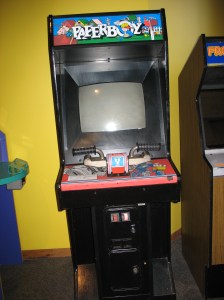
I recently saw an old Paperboy arcade game. The 1980s game had players take the paperboy through a variety of adventures and obstacles to deliver the paper to subscribers (and to throw extra papers at non-subscribers). You win by successfully delivering a week’s worth of newspapers to your subscribers.

My nostalgia led me on a hunt to find out the history of Paperboy. Did you know Paperboy has its own Wikipedia link and that there was a version that allowed you to chooseΒ to beΒ Β a Papergirl instead of a Paperboy? To my surprise, I also learned a version of Paperboy was released for XBox 360 in 2007.

It’s ironic, to say the least, that a video version of Paperboy might outlive the “career” itself. I wonder:Β  If we threw newspapers at non-subscribers like Paperboy, could we get them to subscribe?

Media Law Case of the Week

For three years, student journalists at Michigan State University have been fighting a legal battle to get access to police records of a campus incident that allegedly included a student covering a victim in gasoline and threatening to set the victim on fire in a dorm room.

Now an Ingham County Circuit Court judge has said the university must turn over some of the information in those police records to the student newspaper.

The Student Press Law Center has the story of how this legal battle unfolded, why it is important to student journalists who weren’t even on the newspaper staff at the time, and why it might not be over here.

Three years to get basic police records.

Keep up the good fight, student journalists.

Newspaper boxes in museums

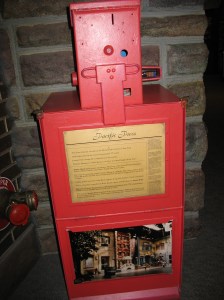
I took my daughter to the Strong National Museum of Play recently and noticed a couple of newspaper boxes like this in the exhibit for Sesame Street.

Museum of Play May 2009 048Five years ago, I wouldn’t have thought much of this. But today, with the current state of the newspaper industry, the sight of a newspaper box in a museum struck me as eerie. I couldn’t help but wonder if this was where newspaper boxes — and indeed, newspapers as we know them — were going to be. Not in our homes and in our hands, but in a museum exhibit.

My 4-year-old knows about newspapers. (How could she not when her mom used to work for one?) But it’s hard not to wonder if in the not-too-distant future children will be asking their parents what that box with the paper in it is when they tour exhibits like this. Five years ago, I don’t think it ever would have occurred to me that newspapers would be in the shape they are now. It’s not that much of a stretch to think that five years from now boxes like this will be gone for good — except for in museums.

Media Law Case of the Week

If a radio host sends e-mails that say a politician is gay, is that libel?

You and I might say no, but Tom Fetzer, who is running to be head of the state of North Carolina’s Republican party, says it is.

He has informed his supporters that he intends to sue radio station WLTT and corporate owner Sea-Comm Media over e-mails sent by radio host Curtis Wright that said Fetzer is gay. Fetzer says he is not.

The News & Observer has the e-mail Fetzer, former mayor of Raleigh, sent to his supporters about the legal action here.

Mr. Fetzer, be prepared to be hit with outrage.