Viewing those missing web pages

Have you ever googled a name or group only to find that the page you want has been changed or removed?

I learned a cool trick to solve that problem from one of my students, Amanda Seef.

Use Internet Archive, put in the URL and voila!

It worked for me. I had googled a person’s name, and the page with all his biographical information had been removed. I put the URL for that page into Internet Archive and up the page came.  I printed it out and had the information I needed.

Thanks, Amanda! It just goes to show that teachers can learn a lot from their students, too.

Best of the Blogs for Teaching Journalism

I’m starting a new occasional feature here focusing on some good reads for journalism teachers. I will be sharing these blog posts with students in my journalism and web design classes.

Gina Chen’s Open Letter to Newspapers at savethemedia. She writes about what she wants from newspapers from the perspective of a newspaper reader, not a journalist. It’s excellent.

Mark Luckie’s Why Journalists Should Learn to Code at 10,000 Words. It’s difficult for journalism students to understand why knowing HTML and CSS might give them an edge. After all, it’s the story that matters, right? Luckie does a great job of explaining why coding matters.

Erica Smith’s Multimedia Toolkit:  55 Sites You Should Know About at graphicdesgnr. This will save me hours — literally — and give me lots of cool new tools to show my students.

Thanks to all for making the life of this journalism teacher a little easier and for making classes more interesting and relevant.

Media Law Case of the Week

I try find hidden nuggets of media law jewels for the Media Law Case of the Week. But this week I am going more mainstream because this tit-for-tat free speech case is so good.

devore-henley-battle

Don Henley of Eagles fame is suing U.S. Senate candidate Charles DeVore for copyright infringement. Henley says use of his hit songs “All She Wants to Do is Dance” and “The Boys of Summer” in DeVore’s YouTube campaign videos violates his copyright.

DeVore, in turn, argues that ” aging liberal rockers” Henley and Mike Campbell, who filed suit with Henley,  are violating his “First Amendment right to political free speech.” DeVore says he wrote new lyrics and the use was obviously parody.

Who will decide? The case has been filed in U.S. District Court in California.  We’ll have to wait and see.

Even the BBC is watching.

Why can’t online newspaper link?!

I love the Buffalo News.  I really do.

But give me a break.

In an ONLINE story about how the city of Buffalo government is releasing salary data online, the readers were given this direction.

The address for Buffalo’s Web site is http://www.city-buffalo.com. The salary data was originally posted on the home page under “Mayor Brown’s Transparent Government Initiative.” Late this afternoon, the title for the posting was changed to “City of Buffalo Employee Salary Information.”

NO hypertext. NO links. NO joke.

In essence, I view this as sending the following message:

“Dear Reader,

We know you understand all this newfangled web stuff, but we don’t. We’re going to try to help you, but this is the best we can do.

Or, if you don’t accept that explanation, how’s this? We’re too lazy to update the story for our web site.

Oh, but trust us to get details right.

Sincerely,

Your Newspaper”

I don’t think newspapers are dead. But they can’t bury their heads in the sand. They’ve got to keep up. Links are not too much for a reader to expect.

Shame on you, Buffalo News.

A man who loves his newspaper

This hysterical look at a man who loves his newspaper is on YouTube. Maybe national ads like this would get attention for newspapers …

Media Law Case of the Week

Cows, you have your privacy.

The Cattle Network (yes, there is a Cattle Network) is reporting that a federal court has ruled that data collected for the National Animal Identification System is not subject to Freedom of Information Act requests.

The National Animal Identification System is used by the U.S. government to trace diseased animals/animal disease outbreaks.

I’m not sure what “sensitive information” would not be able to be released under FOIA, but The Cattle Network mentions “sensitive producer information about premises, businesses and animals .” (Seems to me if there is a disease outbreak, information needs to come out…)

I’m also not sure what FOIA exemption this falls under. Trade secrets doesn’t seem right. Maybe bovine secrets?

Citizen Journalism standards published

The Huffington Post has published standards for citizen journalism.

It is, in essence, some of the basics taught in Newswriting 101 classes across the nation.

Case in point:

1. MAKE SURE YOU HAVE CHECKED FOR SPELLING AND GRAMMATICAL ERRORS.

One of the items on the list, however, is something that even “professional” journalists sometimes forget to do.

4. IF YOU MAKE A NEGATIVE, FACT-BASED ASSERTION A PERSON OR ORGANIZATION, YOU NEED TO REACH THAT PERSON OR ORGANIZATION FOR COMMENT.

Just a few weeks ago, I watched a local TV newscast lead with a story on a BOCES tutor accused of having sex with a student. At no point did the reporter even mention trying to get a comment from the tutor or the tutor’s lawyer.

How does that happen?

I can guess how. You are putting together a story on deadline. Parents and school officials are easy to reach. The accused is not so easy. But that doesn’t mean journalists shouldn’t try to reach the accused and let the news audience know that.

Congrats to the Huffington Post for making its standards clear and explaining some basics of journalism to those who didn’t go to J-School but want to report. Making these processes clear can only help journalism.

Newspaper fined for reporter’s fall?!

Let me get this straight.

According to a Buffalo News story by Michael Beebe, inspectors at the federal Occupational Health and Safety Administration want to fine the News $31,500 for allowing its sports reporter to go to an unsafe press box while covering a game.

What?!

Sports reporter Tom Borrelli died last year from injuries he sustained when he fell while climbing stairs to a press box at Buffalo’s All High Stadium. The Buffalo school district has since been cited by New York state investigators for five safety violations involving those stairs.

But an OSHA inspector tells Beebe in the story that because the News did not “prevent” its reporters from using the press box it should be fined.

Under this rationale, does it not seem logical that the government should/would fine media outlets for not “preventing” their reporters from reporting in unsafe conditions like — oh, I don’t know — WARS?

Areas where there are a lot of crimes?

Fire and crime scenes?

The list could go on and on. And this case could set a chilling precedent for news organizations. Do they decide to risk potential fines or do they decide to not cover a story because in these tight economic times they cannot afford the risk of OSHA fines?

It is not the fault of the press that reporters sometimes do their jobs in unsafe conditions. The responsibility lies elsewhere. Perhaps the government should focus on the cause of the problem instead of the press.

Media Law Case of the Week

Before I get into the Media Law Case of the Week, I want to mention the great progress the federal shield law has made. It passed in the House.  (For more specifics of what’s in it, see here.) Now on to the Senate. Fingers crossed…

And now, the case of the week has to do with invasion of privacy, a college student and My Space, the popular social networking site.

A California appellate court ruled last week that thoughts posted on My Space are not private.

The ruling stems from the interesting case of a college student who professed her hatred of her hometown on her My Space page. Her rant ran in a local paper, and her family was allegedly bombarded with hate mail.

Claiming invasion of privacy, the student and her family sued the paper, its publishers and the person who pointed out the student’s My Space musings to the newspaper. They claimed invasion of privacy and intentional infliction of emotional distress.

They lost.

For full details of the case, including a link to the court’s ruling, see the Wall Street Journal piece here.

Supreme Court justice bobbleheads

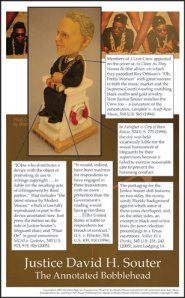
The Green Bag: An Entertaining Journal of the Law has been making bobbleheads of Supreme Court

This bobblehead -- and others like this -- are pictured on Greenbag.

This bobblehead -- and others like this -- are pictured on Greenbag.

justices. They are hysterical, but also informative.

I used this “Annotated Bobblehead” image of Justice David Souter to tie in the 2 Live Crew “Pretty Woman” copyright case in my media law class today. The students loved it. I just wish I could get my hands on the actual bobblehead doll.

Trust me. It’s definitely work clicking the Greenbag link to check this out.